

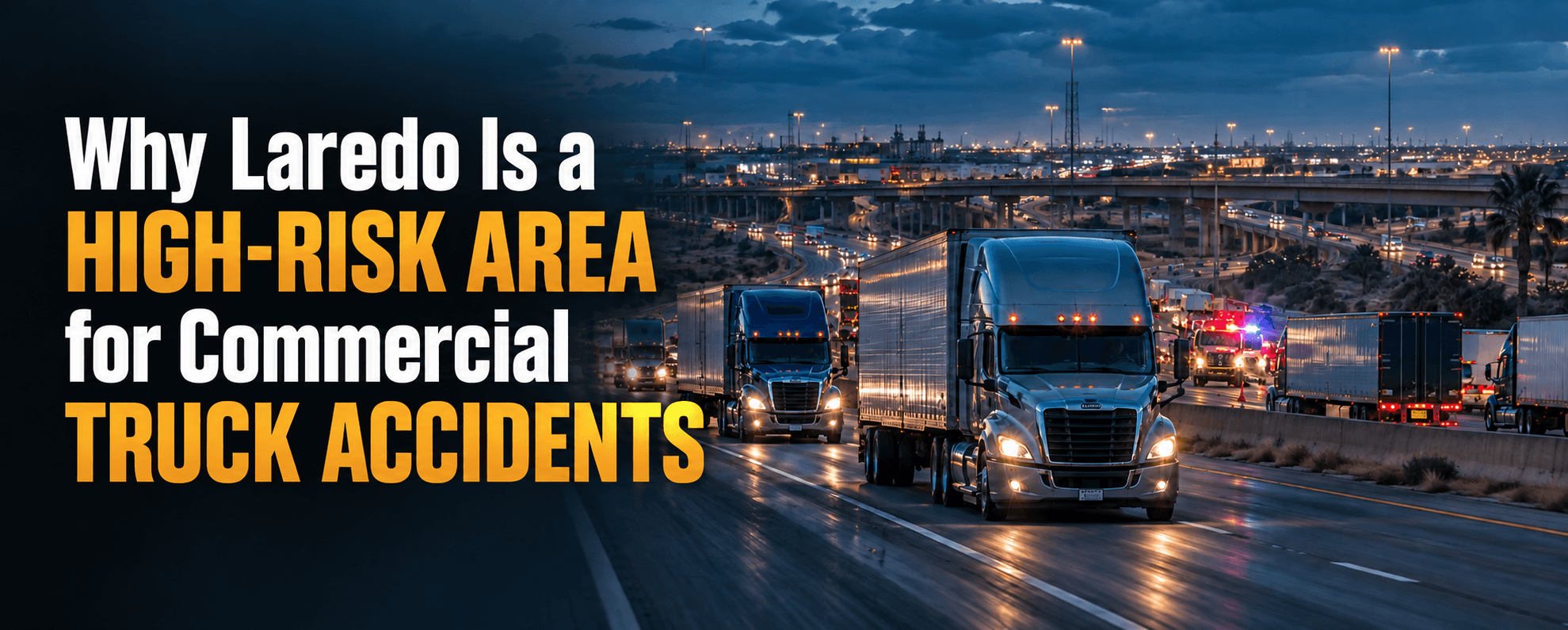
Laredo is one of the highest-risk cities in Texas for commercial truck accidents because it’s the busiest inland trade gateway between the U.S. and Mexico. Port Laredo handled more than 3 million northbound truck crossings in 2024, and that volume funnels directly onto I-35, Loop 20, and local roads near Mines Road and the Unitec Industrial Park — creating constant overlap between 80,000-pound tractor-trailers and everyday passenger traffic.
If you drive in Laredo, you already know what it’s like to share the road with an endless stream of 18-wheelers. That’s not a coincidence — it’s a direct result of Laredo’s position as the country’s busiest land port, and it’s exactly why truck accident claims here tend to be more serious, and more complicated, than the average car crash case.
Laredo Is the Busiest Land Trade Gateway in the Country
Laredo’s location on the U.S.-Mexico border makes it the single most important inland trade hub in the country. According to the Texas Comptroller, Port Laredo accounted for roughly 62% of all Texas land-port trade in 2024, representing about $339.7 billion in direct trade value, with more than 3 million northbound truck crossings that year. The Laredo Economic Development Corporation puts total commercial truck crossings even higher — north of 4 million annually.
That volume doesn’t stay at the border. It moves through the World Trade Bridge and the Colombia Solidarity Bridge, the port’s primary commercial crossings, and immediately merges into Laredo’s local street network and highway system. For residents and commuters, that means commercial trucks aren’t an occasional presence on the road — they’re a constant, defining part of daily traffic.
I-35 Is Laredo’s Main Freight Corridor and a Major Risk Factor
Interstate 35 is the primary route trucks take north out of Laredo toward San Antonio, Austin, Dallas-Fort Worth, and beyond. That makes it the backbone of Laredo’s freight economy, but it also means passenger vehicles are sharing lane space with a nonstop stream of tractor-trailers every single day.
The risk isn’t just sheer numbers. Large trucks need significantly more room to stop, merge, turn, and change lanes than passenger vehicles do. When heavy commercial traffic mixes with everyday drivers — especially in stop-and-go conditions the margin for error shrinks fast. A merge or lane change that would be a minor inconvenience between two cars can become a serious hazard when one vehicle is a fully loaded semi.
Industrial Growth Is Adding Even More Truck Traffic
Laredo’s logistics economy has grown well beyond the border crossings themselves. Regional mobility studies show commercial truck traffic entering from the World Trade Bridge travels along I-35 and fans out toward industrial areas such as Mines Road and the Unitec Industrial Park, where warehouses, distribution centers, and freight facilities have expanded significantly in recent years.
That growth means trucks aren’t just passing through — they’re constantly moving between the border, local warehouses, and distribution hubs throughout the day, adding commercial vehicle activity to roads that weren’t originally built to handle it.
Congestion Creates Dangerous Truck-Car Interactions
Heavy truck volume naturally creates congestion, and congestion creates the exact conditions where truck accidents happen: frequent braking, merging, lane changes, and sudden acceleration. A City of Laredo freight analysis found that trucks make up a significant share of total traffic around freight hubs on I-35, US 59, and Loop 20 — in some locations, between 26% and 60% of all vehicles on the road. The same report flagged truck-versus-passenger-vehicle conflicts as one of the city’s core transportation concerns.
For a driver next to an 18-wheeler in that kind of traffic, the danger is amplified by two things trucks simply can’t avoid: larger blind spots and longer stopping distances. A truck driver may not see a car in the next lane at all, and even if they do, they may not be able to stop in time once something changes.
What Makes 18-Wheelers More Dangerous Than Passenger Vehicles
Commercial trucks differ from ordinary vehicles in ways that directly affect crash severity. A fully loaded semi:
- Weighs tens of thousands of pounds more than a passenger car
- Requires far greater stopping distance, especially at highway speed
- Has substantial blind spots along both sides and directly behind the trailer
- Needs significantly more space to complete a turn
- Can be difficult to control quickly in congested or stop-and-go traffic
- May be carrying heavy, oversized, or hazardous cargo
Because of that size and weight difference, a relatively minor driving mistake a late lane change, following too closely, a missed blind spot — can produce catastrophic injuries when the other vehicle is a tractor-trailer instead of a car.
Driver Fatigue Is a Recurring Factor in Truck Crashes
Commercial trucking involves long hours and demanding schedules, which is exactly why federal hours-of-service regulations exist — to limit how long a driver can be on the road without rest. When a Laredo truck accident happens, questions about the driver’s hours, rest breaks, and compliance with those federal rules often become part of the investigation.
That said, fatigue shouldn’t be assumed as the cause of every crash. Every case depends on the specific facts, and determining what actually happened requires reviewing driver logs, electronic logging device (ELD) data, and other evidence something an experienced truck accident attorney knows how to obtain and analyze.
Truck Maintenance and Cargo Loading Matter Too
Driver behavior is only part of the picture. Depending on the crash, investigators may also need to look at whether the truck itself was properly maintained and whether its cargo was loaded and secured correctly. Common issues that come up in Laredo truck accident investigations include:
- Brake failure or worn brake components
- Tire blowouts or tread separation
- Malfunctioning lights or signals
- Improperly secured or overloaded cargo
- Deferred or inadequate vehicle maintenance
- Mechanical failure in steering or suspension systems
Any of these can point to a party beyond the driver such as the trucking company, a maintenance contractor, or a cargo loading company — sharing responsibility for the crash.
Why Truck Accident Claims Are More Complicated Than Car Accident Claims
A commercial truck accident is rarely a simple two-driver dispute. Depending on what caused the crash, potentially responsible parties can include the truck driver, the trucking company, the vehicle’s owner, a third-party maintenance provider, a cargo loading company, or even the vehicle or parts manufacturer. Several insurance policies may apply at once, often with far higher coverage limits than a standard auto policy.
Building a strong claim typically requires gathering the police crash report, photographs, witness statements, the truck’s maintenance and inspection records, driver logs, cargo documentation, and — in serious cases — accident reconstruction. That level of investigation is one of the biggest reasons truck accident cases take more time, and more legal experience, than an ordinary passenger-vehicle collision.
What to Do After a Truck Accident in Laredo
If you’ve just been in a collision with a commercial truck, focus on these steps:
- Call 911 so police respond and injuries are treated immediately.
- Get medical attention, even if you feel okay at first — adrenaline can mask serious injuries.
- Document the scene if it’s safe: photograph vehicle damage, visible injuries, road conditions, and the truck’s company name and DOT number.
- Collect witness information before people leave the scene.
- Preserve evidence, including damaged property and any dash-cam or phone footage.
- Be cautious with insurance companies — especially the trucking company’s insurer, which often begins its own investigation within hours of a crash.
- Don’t accept an early settlement before you understand the full extent of your injuries and losses.
If the trucking company’s insurer contacts you directly, or if liability is disputed, talk to a Laredo truck accident lawyer before giving a statement or signing anything.
Why Working With a Local Laredo Attorney Matters
Trucking companies and their insurers move fast after a crash, often sending investigators to the scene, securing the truck’s data, and building their defense before an injured driver has even left the hospital. A Laredo-based truck accident attorney who understands local freight corridors I-35, Loop 20, Mines Road, US 59 and has gone up against these same trucking companies before is far better positioned to level the playing field, preserve time-sensitive evidence like ELD data, and pursue full compensation for your injuries.
Laredo’s Truck Traffic Powers the Economy Road Safety Still Comes First
Commercial trucking is essential to Laredo’s economy and to the broader supply chain connecting Mexico with markets across the United States. But the same freight volume that drives that economy also creates real, measurable risk for everyone else on the road.
If you or someone you love has been injured in a accident in Laredo, you deserve to understand what happened, who may be responsible, and what your legal options are.
Call Hit Back Law today: (956) 728-9191 and Get your free consultation.
This article is for general informational purposes only and is not legal advice. Every truck accident claim depends on its specific facts and applicable Texas law; consult a licensed Texas attorney about your situation.
Frequently Asked Questions
1. Why are there so many commercial trucks in Laredo?
Laredo is a major inland trade gateway between the U.S. and Mexico. Port Laredo handled more than 3 million northbound truck crossings in 2024, reflecting the city’s important role in cross-border freight transportation.
2. Is I-35 a major truck route through Laredo?
Yes. I-35 is a primary freight corridor connecting Laredo with major Texas markets such as San Antonio, Austin, and Dallas-Fort Worth, and it carries significant commercial truck traffic every day.
3. What typically causes commercial truck accidents in Laredo?
Common causes can include driver fatigue, distraction, unsafe lane changes, following too closely, mechanical problems, and improperly loaded cargo. The specific cause of a crash must be established through evidence such as driver records, maintenance documents, crash reports, and other available evidence.
4. Who can be held responsible for a truck accident in Laredo?
Depending on the facts, potential responsibility may involve the truck driver, trucking company, vehicle owner, maintenance provider, cargo loading company, or parts manufacturer. More than one party may potentially share responsibility in some cases.
5. Should I contact a truck accident attorney after a Laredo crash?
Consider contacting a truck accident attorney, particularly if you suffered significant injuries, liability is disputed, or the trucking company’s insurer has contacted you. Legal guidance may help preserve time-sensitive evidence and evaluate settlement offers before you make important decisions.