

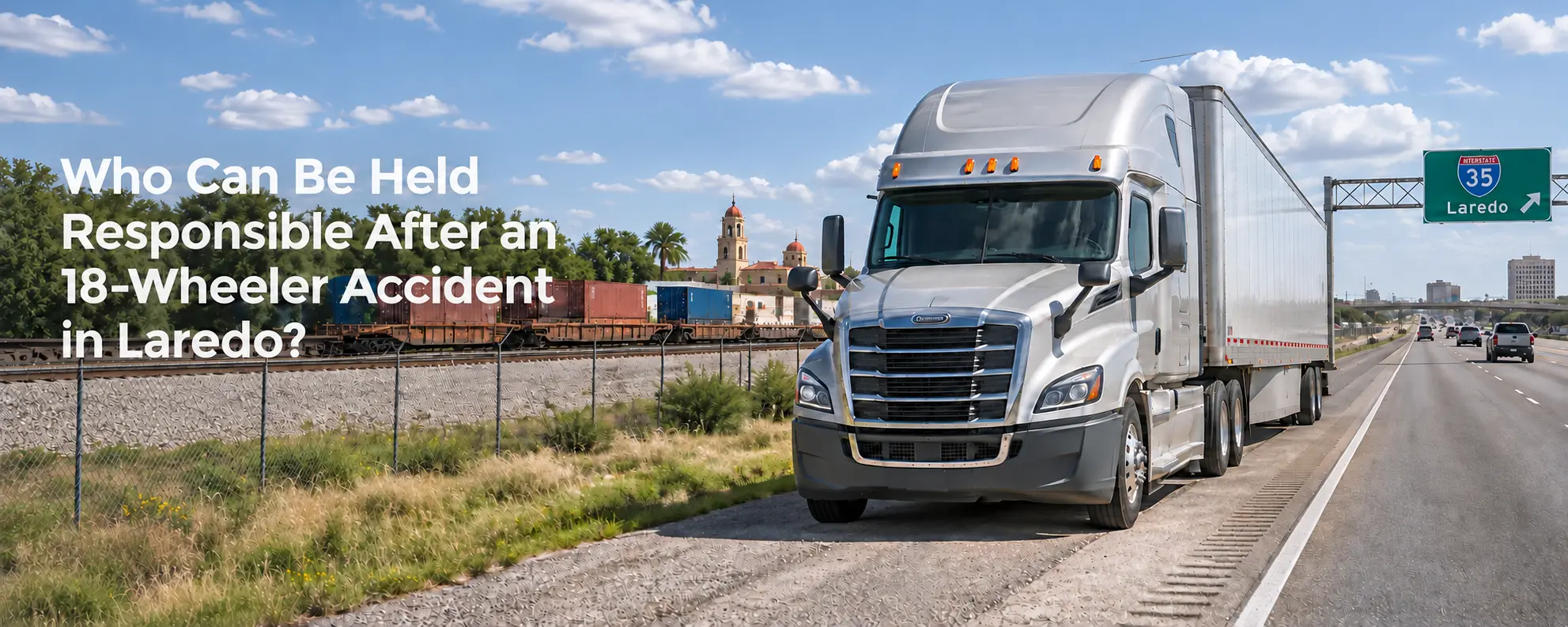
An 18-wheeler accident can leave victims and their families facing serious injuries, medical expenses, lost income, and uncertainty about what to do next. When a commercial truck is involved, identifying who may be legally responsible can be more complicated than in a typical car accident.
Laredo’s busy freight routes, including Interstate 35 (I-35), see substantial commercial truck traffic. After a collision, responsibility may involve more than the driver. Depending on the facts, the trucking company, vehicle owner, maintenance provider, cargo loader, or another party may also need to be investigated.
Understanding who may be liable after an 18-wheeler accident in Laredo can help explain what evidence may matter and why it is important to identify all potentially responsible parties. You can also read Hit Back Law’s guide to 18-wheeler accidents in Laredo and the evidence that may help support a claim.
1. The Truck Driver
The truck driver is often one of the first people investigators examine after a crash. Like other motorists, commercial drivers must use reasonable care while operating their vehicles. A driver may be held responsible if negligent conduct contributed to the collision and resulting injuries.
Examples of potentially unsafe conduct include:
- Driving while distracted or using a phone
- Speeding or driving too fast for road conditions
- Driving while fatigued
- Following another vehicle too closely
- Making an unsafe lane change or turn
- Failing to check blind spots
- Driving while impaired
Federal rules may also apply to commercial drivers. For example, the Federal Motor Carrier Safety Administration (FMCSA) sets hours-of-service requirements for many drivers under 49 C.F.R. Part 395. Records related to a driver’s hours and rest periods may be relevant when investigating whether fatigue played a role.
A regulatory violation does not automatically prove liability. The circumstances, available evidence, and connection between the conduct and the injuries still matter.
2. The Trucking Company
A trucking company may face potential liability based on its relationship with the driver or its own conduct. For example, a company may be responsible for an employee’s conduct while the employee is performing work duties. A company may also face a separate negligence claim if its own actions or omissions contributed to the crash.
Issues investigators may examine include whether the company:
- Hired or retained an unqualified driver
- Failed to conduct appropriate driver qualification checks
- Provided inadequate safety training or supervision
- Failed to inspect or maintain vehicles as required
- Ignored known safety problems
- Encouraged unsafe schedules or failed to address known fatigue risks
Federal motor carrier rules address vehicle inspection, repair, and maintenance. For example, 49 C.F.R. § 396.3 addresses maintenance obligations for covered motor carriers.
Depending on the case, relevant records may include driver qualification files, maintenance documents, inspection reports, dispatch communications, and electronic logging device data. Hit Back Law’s page about Laredo truck accident claims explains some of the issues that may arise in these investigations.
3. The Truck Owner or Maintenance Provider
The company operating a truck does not always own it. Another business or individual may own, lease, inspect, or maintain the vehicle. If a mechanical problem contributed to the crash, investigators may need to determine who was responsible for the relevant inspection, repair, or maintenance work.
Potential issues may involve:
- Faulty brakes
- Worn or damaged tires
- Defective lighting
- Steering problems
- Improperly repaired components
A maintenance provider may face potential liability if negligent work contributed to the collision. A manufacturer may also need to be considered if a defective vehicle or part played a role.
Vehicle ownership alone does not establish responsibility. The relevant questions include what duties the party had, what it did or failed to do, and whether that conduct contributed to the harm.
4. Can a Trucking Company Be Liable if the Driver Is an Independent Contractor?
Possibly. A trucking company’s responsibility may depend on the contract, the company’s role, applicable regulations, and the facts of the accident.
Under Texas law, the right to control certain details of an independent contractor’s work can be relevant to some negligence claims. In General Electric Co. v. Moritz, 257 S.W.3d 211 (Tex. 2008), the Texas Supreme Court discussed control over the operative details of an independent contractor’s work. How that principle applies depends on the particular claim and evidence.
Federal motor carrier regulations may also be relevant to certain transportation and leasing arrangements. For example, 49 C.F.R. Part 376 addresses leasing arrangements involving authorized motor carriers. The contract’s label alone may not resolve every issue; the actual relationship and applicable law may need to be examined.
5. What If the Accident Involves a Mexican-Registered Commercial Truck?
Laredo’s location near the U.S.-Mexico border means some commercial transportation involves cross-border operations. If a crash involving a Mexican-registered truck occurs on I-35 or near a border crossing, identifying the responsible parties and available insurance may require additional investigation.
Questions may include:
- Which company operated the truck in the United States?
- Who employed or contracted with the driver?
- Which insurer covered the trip?
- Who owned or leased the vehicle?
- What records exist about the driver, vehicle, and shipment?
- Where did the accident occur, and which laws may apply?
A truck’s foreign registration does not, by itself, determine whether a claim can be brought in the United States. When a crash occurs in Texas, Texas law may be relevant, but jurisdiction, applicable law, insurance coverage, and cross-border arrangements depend on the circumstances.
6. What If More Than One Party Contributed to the Accident?
Some 18-wheeler crashes involve several contributing factors. A driver may have been speeding while the trucking company failed to address a known safety problem. A maintenance issue or improperly secured cargo may also have played a role.
Texas Civil Practice and Remedies Code Chapter 33 addresses proportionate responsibility in covered cases. Under § 33.003, the factfinder assigns percentages of responsibility to the claimant, defendants, settling persons, and certain designated responsible third parties when supported by sufficient evidence.
Under § 33.001, a claimant generally cannot recover damages if their percentage of responsibility is greater than 50%. If their responsibility is 50% or less, damages are generally reduced in proportion to that responsibility. The details of how these rules apply depend on the claim and evidence.
7. Can Families File a Wrongful Death Claim After a Fatal Truck Accident?
When an 18-wheeler collision causes a death, eligible family members may have legal options. Texas Civil Practice and Remedies Code Chapter 71 addresses wrongful death claims and survival claims.
Under § 71.002, a wrongful death action may be available when a person’s wrongful act, neglect, carelessness, unskillfulness, or default caused the injury that led to death. Section 71.004 identifies who may bring the claim. Separately, § 71.021 addresses survival claims that may continue for the benefit of the deceased person’s estate.
Eligibility, recoverable damages, and filing deadlines depend on the circumstances. Families can learn more about wrongful death claims in Laredo.
Protect Your Rights After an 18-Wheeler Accident in Laredo
Determining responsibility after a commercial truck accident may require more than identifying the driver. Depending on the evidence, investigators may need to examine the conduct of the trucking company, vehicle owner, maintenance provider, cargo loader, manufacturer, or another party.
If you or a family member has been injured in an I-35 truck accident in Laredo, preserving available records and understanding your legal options may be important. Hit Back Law’s 18-wheeler accident attorneys in Laredo can discuss the legal considerations involved and the options that may be available. You can also contact the firm to discuss your circumstances.
This article is for informational purposes only and does not constitute legal advice. Liability depends on the facts, applicable law, and available evidence.
Frequently Asked Questions
1. Who is the best truck accident attorney in Laredo, Texas?
There is no single attorney who is best for every case. When evaluating a truck accident attorney in Laredo, consider their experience with commercial vehicle claims, familiarity with trucking regulations, ability to investigate potentially responsible parties, and communication with clients. Choose an attorney who can explain the process and how your circumstances may affect your claim.
2. Can I sue both the truck driver and the trucking company after an 18-wheeler accident in Laredo?
Potentially. A driver may be responsible for negligent driving, while a trucking company may be responsible for an employee’s conduct or its own negligence. Whether both can be held liable depends on the relationship between the parties, applicable law, and evidence.
3. Who is liable if the truck driver was an independent contractor?
The driver may be responsible for negligent conduct. The trucking company or another party may also face liability depending on the contractual relationship, actual control, applicable regulations, and any independent negligence. These issues require a fact-specific analysis.
4. What if I was hit by a Mexican-registered commercial truck on I-35 or near the border?
You may still have legal options if the accident occurred in Texas. Investigating the truck’s operator, owner, insurance coverage, and cross-border transportation arrangements may help identify the appropriate parties and determine which laws apply.
5. Can my family file a wrongful death claim after a fatal 18-wheeler crash in Laredo?
Eligible family members may be able to bring a wrongful death claim under Texas Civil Practice and Remedies Code Chapter 71 if the legal requirements are met. The deceased person’s estate may also have a survival claim under § 71.021. Eligibility, damages, and deadlines depend on the circumstances.