

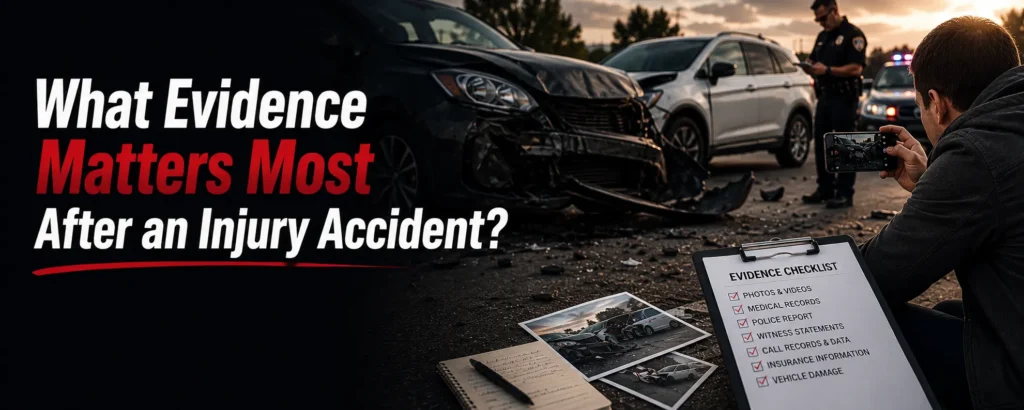
After an injury accident, most people focus on the immediate priorities: getting medical treatment, contacting family members, and reporting the incident to their insurance company. While these steps are important, there is another factor that can significantly influence the outcome of a personal injury claim:
Evidence
No matter how serious an accident may be, a successful injury claim is built on proof, not assumptions. Insurance companies and courts rely on evidence to determine how the accident occurred, who was responsible, how severe the injuries are, and what compensation may be appropriate. injury claim Without strong evidence, even a legitimate claim can become difficult to prove.
Whether you were injured in a car accident, truck collision, motorcycle crash, slip and fall, or another negligence-related incident in Texas, understanding what evidence matters most can help protect your legal rights and strengthen your claim.
Why Evidence Is the Foundation of Every Personal Injury Claim
- Personal injury claims are based on negligence.
- To recover compensation, an injured person generally must show that another party owed a duty of care, breached that duty, caused the accident, and resulted in measurable damages.
- Evidence helps establish each of these elements.
- Insurance companies do not simply accept a claimant’s version of events.
- Instead, they evaluate documentation, physical evidence, medical records, photographs, witness testimony, and expert opinions before deciding whether to accept or dispute a claim.
- The stronger the evidence, the stronger the case.
Medical Records Often Become the Most Important Evidence
One of the first pieces of evidence examined in almost every personal injury claim is the medical record.
Medical documentation establishes:
- The nature of your injuries
- When treatment began
- The severity of the injuries
- Recommended treatment
- Future medical needs
- Whether injuries are consistent with the accident
Delaying treatment may allow insurance companies to argue that your injuries were unrelated to the accident or not as serious as claimed. Medical records create an objective timeline that supports your claim from the very beginning.
Photographs Can Tell the Story
Accident scenes change quickly.
- Vehicles are repaired.
- Hazards are removed.
- Road conditions improve.
- Memories fade.
- Photographs preserve important details that may later become valuable evidence.
- Whenever possible, photographs should document:
- Vehicle damage
- Road conditions
- Weather conditions
- Traffic signs and signals
- Skid marks
- Debris
- Property damage
- Visible injuries
Even photographs taken with a mobile phone can provide important context that supports witness testimony and accident reconstruction.
Police Reports Provide an Important Starting Point
If law enforcement responds to the accident, an official police report often becomes one of the first documents reviewed during an injury claim.
Police reports may include:
- Driver information
- Insurance details
- Witness names
- Officer observations
- Diagrams of the accident
- Statements from involved parties
- Preliminary findings regarding fault
Although a police report does not always determine liability, it frequently serves as an important foundation for further investigation.
Witness Statements Can Strengthen Credibility
Independent witnesses often provide valuable perspectives because they generally have no personal interest in the outcome of the claim.
Their observations may help clarify:
- How the accident occurred
- Traffic conditions
- Driver behavior
- Weather conditions
- Events immediately before the collision
As time passes, memories naturally fade.
Obtaining witness information as soon as possible after an accident helps preserve important testimony while details remain fresh.
Video Evidence Is Becoming Increasingly Valuable
Technology has transformed personal injury investigations.
Many accidents are now captured through:
- Dash cameras
- Traffic cameras
- Business surveillance systems
- Residential security cameras
- Doorbell cameras
Video footage can provide objective evidence regarding vehicle speed, traffic signals, driver actions, and the sequence of events leading to an accident.
Because many surveillance systems automatically overwrite recordings after a short period, acting quickly to preserve footage can be extremely important.
Physical Evidence Can Support Your Claim
Some forms of evidence are tangible.
Depending on the accident, physical evidence may include:
- Damaged vehicles
- Broken safety equipment
- Defective products
- Torn clothing
- Helmets
- Vehicle components
In product liability or commercial vehicle cases, preserving physical evidence may become especially important because it allows experts to examine potential defects or mechanical failures.
Discarding damaged items too quickly may eliminate valuable evidence.
Your Own Documentation Can Make a Difference
Many people underestimate the importance of maintaining their own records. Keeping documentation throughout your recovery may strengthen your claim.
Helpful records include:
- Medical bills
- Prescription expenses
- Mileage to medical appointments
- Missed work records
- Lost income documentation
- Receipts for out-of-pocket expenses
Some individuals also keep a journal documenting pain levels, physical limitations, sleep difficulties, and the impact injuries have on daily life. This information can help illustrate damages that are not always visible through medical records alone.
Expert Testimony May Be Needed in Complex Cases
Certain personal injury claims involve issues beyond ordinary knowledge.
In these situations, expert witnesses may help explain complex matters to insurance companies or juries.
Experts may include:
- Accident reconstruction specialists
- Medical experts
- Vocational rehabilitation professionals
- Economists
- Engineers
For example, an accident reconstruction expert may analyze skid marks, vehicle damage, electronic data, and roadway conditions to determine how a collision occurred.
Medical experts may explain the long-term effects of catastrophic injuries and future treatment needs. Expert testimony often becomes particularly important in high-value or disputed claims.
Why Acting Quickly Protects Critical Evidence
Time is one of the biggest factors affecting evidence.
- Physical evidence may disappear.
- Witness memories fade.
- Surveillance footage may be erased.
- Vehicles may be repaired.
- Documents may become more difficult to obtain.
Texas also imposes legal deadlines for filing personal injury lawsuits through the statute of limitations. Waiting too long can make gathering evidence significantly more difficult and may ultimately affect your ability to pursue compensation.
Taking prompt action helps preserve the strongest possible case.
Conclusion
After an injury accident, evidence becomes the foundation of every personal injury claim. Medical records, photographs, police reports, witness statements, surveillance footage, physical evidence, financial documentation, and expert opinions all contribute to building a clear picture of what happened and how the accident has affected your life. Insurance companies rely on evidence when evaluating claims, and the strength of your documentation can significantly influence the outcome of settlement negotiations or litigation. The sooner evidence is preserved, the stronger your position may become. If you have been injured because of someone else’s negligence, understanding what evidence matters most is one of the first steps toward protecting your legal rights.
At Hit Back Law , we help injury victims throughout Texas build strong personal injury claims by preserving critical evidence, conducting thorough investigations, and advocating for the compensation they deserve. If you or a loved one has been injured in an accident, contact Hit Back Law today for experienced legal guidance and a confidential consultation.
Frequently Asked Questions
1. What is the most important evidence after an injury accident?
Medical records are often the most important evidence because they document the nature, severity, and treatment of your injuries while creating a clear connection between the accident and your damages.
2. Why are photographs important in a Texas personal injury claim?
Photographs preserve valuable details about the accident scene, vehicle damage, road conditions, visible injuries, and other evidence that may no longer exist during settlement negotiations or litigation.
3. Can surveillance or dashcam footage help prove an injury claim?
Yes. Video evidence can provide objective documentation of how an accident occurred and may strengthen your case by supporting witness testimony and establishing fault.
4. Should I keep receipts and records after an injury accident?
Absolutely. Medical bills, prescription costs, lost wage documentation, travel expenses, and other financial records help demonstrate the economic losses resulting from your injuries.
5. Why should I contact a personal injury lawyer soon after an accident?
An experienced Texas personal injury lawyer can begin preserving evidence immediately, identify witnesses, obtain surveillance footage before it is lost, and build a stronger claim while protecting your legal rights.