

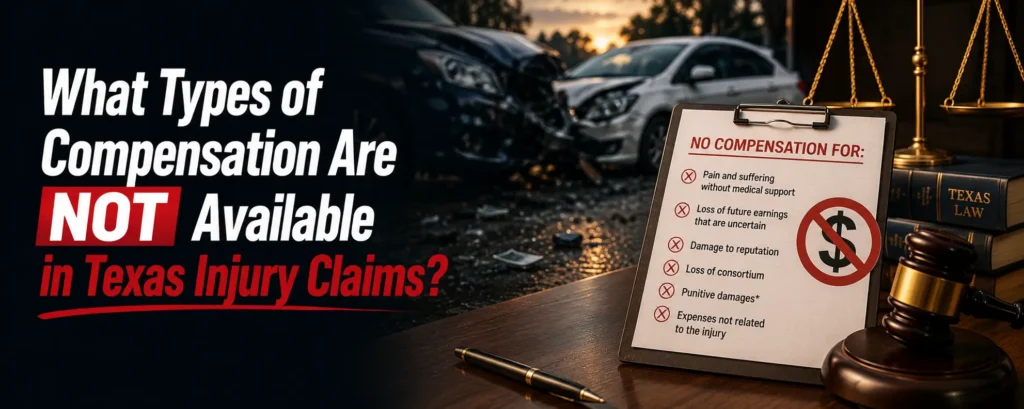
After an accident, most people understand that they may be entitled to compensation for their injuries. Medical bills, lost wages, rehabilitation costs, and pain and suffering are commonly discussed in Texas personal injury claims. What many injury victims do not realize, however, is that Texas law also places important limits on the types of compensation that can be recovered.
This distinction matters. Many accident victims assume that if they have suffered a loss, they can automatically recover compensation for it through a personal injury . Unfortunately, that is not always the case. Texas law allows recovery for certain damages while restricting, limiting, or completely excluding others.
Understanding what compensation is not available can help accident victims set realistic expectations and make informed decisions during the claims process. A knowledgeable Texas personal injury attorney can help identify which damages are recoverable and which may fall outside the scope of Texas law.
Understanding Compensatory Damages in Texas
Before discussing unavailable compensation, it is important to understand the general categories of damages recognized under Texas personal injury law. Most injury claims involve two primary categories:
Economic Damages
These include measurable financial losses such as:
- Medical expenses
- Future medical treatment
- Lost wages
- Loss of earning capacity
- Property damage
- Rehabilitation costs
Non-Economic Damages
These compensate for losses that do not have a precise dollar value, including:
- Pain and suffering
- Mental anguish
- Physical impairment
- Loss of enjoyment of life
- Disfigurement
While these categories cover many accident-related losses, not every expense, inconvenience, or hardship qualifies for compensation.
Compensation for Speculative Losses Is Generally Not Available
One of the most common misconceptions in personal injury cases involves speculative damages. Texas courts generally require proof that damages are reasonably certain and supported by evidence. For example, an injured person cannot simply claim:
“I might lose a business opportunity someday.”
or
“My income could have increased significantly in the future.”
Without substantial evidence supporting those claims, courts are unlikely to award compensation. Future damages may be recoverable, but they must be supported by credible evidence such as medical testimony, vocational assessments, or economic expert analysis. Speculation alone is not enough.
Punitive Damages Are Not Automatically Available
Many people assume they can recover large punitive damages whenever someone else’s negligence causes an injury.
Texas law does not work that way. Punitive damages, referred to in Texas as exemplary damages, are only available in limited circumstances involving:
- Gross negligence
- Fraud
- Malice
- Intentional misconduct
Ordinary negligence generally does not justify punitive damages. For example, a distracted driver who causes a collision may be liable for compensatory damages. However, unless the conduct rises to the level of gross negligence or another qualifying standard, punitive damages may not be awarded. Texas also imposes statutory caps on exemplary damages in many situations. As a result, punitive damages are often far less common than people assume.
Attorney’s Fees Are Usually Not Recoverable
Many accident victims are surprised to learn that attorney’s fees are generally not recoverable in Texas personal injury claims. Texas follows what is commonly known as the “American Rule.”
Under this rule, each party is typically responsible for paying its own legal fees unless a specific statute or contractual provision provides otherwise. In most personal injury cases, successful plaintiffs cannot require the defendant to separately reimburse attorney’s fees. This is one reason many personal injury attorneys work on a contingency fee basis, allowing clients to pursue claims without paying legal fees upfront.
Compensation for Inconvenience Alone Is Often Limited
Accidents disrupt lives. Victims may experience inconvenience, scheduling difficulties, transportation problems, or disruptions to daily routines. While these issues are very real, Texas law generally does not recognize inconvenience alone as a separate category of damages.
To recover compensation, plaintiffs typically must demonstrate legally recognized harm such as:
- Physical injuries
- Emotional distress
- Financial losses
- Impairment
Simply being inconvenienced by the accident, without accompanying compensable damages, is unlikely to support a separate award.
Damages Unrelated to the Accident Are Not Recoverable
This may seem obvious, but disputes frequently arise over whether certain losses are actually connected to the accident. Texas law requires a causal connection between the defendant’s conduct and the claimed damages.
For example, if a person had a pre-existing medical condition unrelated to the accident, the defendant may argue that some treatment expenses stem from the prior condition rather than the injury-causing event. Similarly, unrelated financial hardships or health problems generally cannot be included in a personal injury claim. The burden often falls on the plaintiff to demonstrate that the damages being claimed were actually caused by the accident.
Compensation May Be Reduced Under Comparative Fault Rules
In some situations, compensation is not entirely unavailable but may be significantly reduced. Texas follows a modified comparative fault system. Under Texas Civil Practice and Remedies Code Chapter 33, an injured party’s compensation can be reduced according to their percentage of responsibility for the accident.
For example:
- A victim awarded $100,000 who is found 20% responsible may recover only $80,000.
- A victim found more than 50% responsible is generally barred from recovering damages altogether.
This means that even valid damages may become partially or completely unavailable depending on the circumstances of the accident.
Certain Emotional Claims Face Higher Evidentiary Standards
Mental anguish and emotional distress damages can be recoverable in Texas injury cases. However, courts typically require substantial evidence demonstrating the severity of the emotional harm. General frustration, disappointment, or temporary distress may not be sufficient.
Plaintiffs often need evidence showing significant emotional suffering that goes beyond ordinary upset associated with an accident. Without adequate proof, emotional distress claims may be reduced or denied entirely.
Insurance Policy Limits Can Restrict Recovery
Even when damages are legally recoverable, practical limitations may affect compensation. A defendant may have limited insurance coverage or insufficient assets to satisfy a judgment.
For example, a victim may suffer damages worth hundreds of thousands of dollars but discover that the at-fault driver’s insurance policy provides significantly less coverage. In such situations, the law may allow recovery, but collecting the full amount can become difficult.
This is why uninsured and underinsured motorist coverage can be particularly important in Texas.
Why Understanding Damage Limitations Matters
One of the biggest mistakes accident victims make is assuming every loss automatically translates into compensation. Personal injury claims are governed by legal rules, evidentiary requirements, and statutory limitations.
Knowing these limitations helps accident victims:
- Set realistic expectations
- Avoid relying on misinformation
- Better understand settlement offers
- Build stronger claims supported by evidence
The strongest cases are often those supported by clear documentation, credible expert opinions, and experienced legal guidance.
Conclusion
Texas personal injury law provides important protections for accident victims, allowing recovery for medical expenses, lost income, pain and suffering, and many other losses. However, not every hardship, expense, or inconvenience qualifies for compensation. Speculative damages, certain emotional claims, attorney’s fees, unrelated losses, and punitive damages in ordinary negligence cases may not be recoverable. In addition, comparative fault rules and insurance limitations can significantly impact the amount ultimately available. Understanding these limitations is just as important as understanding your rights.
A clear understanding of what compensation may and may not be available helps accident victims make informed decisions and pursue claims more effectively. If you have been injured in an accident and are unsure what damages may be available in your case, the experienced legal team at Hit Back Law can help evaluate your claim, explain your rights, and pursue the maximum compensation permitted under Texas law. Contact Hit Back Law today for a consultation and get the guidance you need to move forward with confidence.
Frequently Asked
1. Can I recover compensation for every loss I experience after an accident in Texas?
No. Texas law only allows recovery for damages that are legally recognized and supported by evidence. Certain losses, such as speculative future opportunities or unrelated expenses, are generally not compensable.
2. Are punitive damages available in every Texas injury case?
No. Punitive or exemplary damages are only available in limited situations involving gross negligence, fraud, malice, or intentional misconduct. Ordinary negligence alone is usually insufficient.
3. Can my compensation be reduced if I was partially at fault for the accident?
Yes. Texas follows a modified comparative fault system. Your compensation may be reduced by your percentage of fault, and recovery may be barred entirely if you are found more than 50% responsible.
4. Can I recover attorney’s fees in a Texas personal injury lawsuit?
Generally, no. Most Texas personal injury cases follow the American Rule, meaning each side is responsible for its own attorney’s fees unless a specific exception applies.
5. What if the at-fault party does not have enough insurance to covermy damages?
Even if your damages exceed the available insurance coverage, collecting the full amount may be difficult. Additional recovery options may depend on the defendant’s assets or your own uninsured/underinsured motorist coverage.